Begin with observation, not correction
A time audit is a short record of how a normal week actually feels and unfolds. It is not a scorecard. The point is not to prove that every minute was useful, or to turn rest into a project. It is to replace a vague feeling of being busy with a clearer picture of what has been taking your attention.
Most people can name the large blocks: work, sleep, study, travel, caring and meals. The surprising part is usually the edges. A half hour spent getting ready, the scattered messages between tasks, an errand that becomes an afternoon, or a tired evening that turns into aimless scrolling can be small in isolation and meaningful when repeated. Seeing those edges is often more helpful than trying to redesign an entire life.
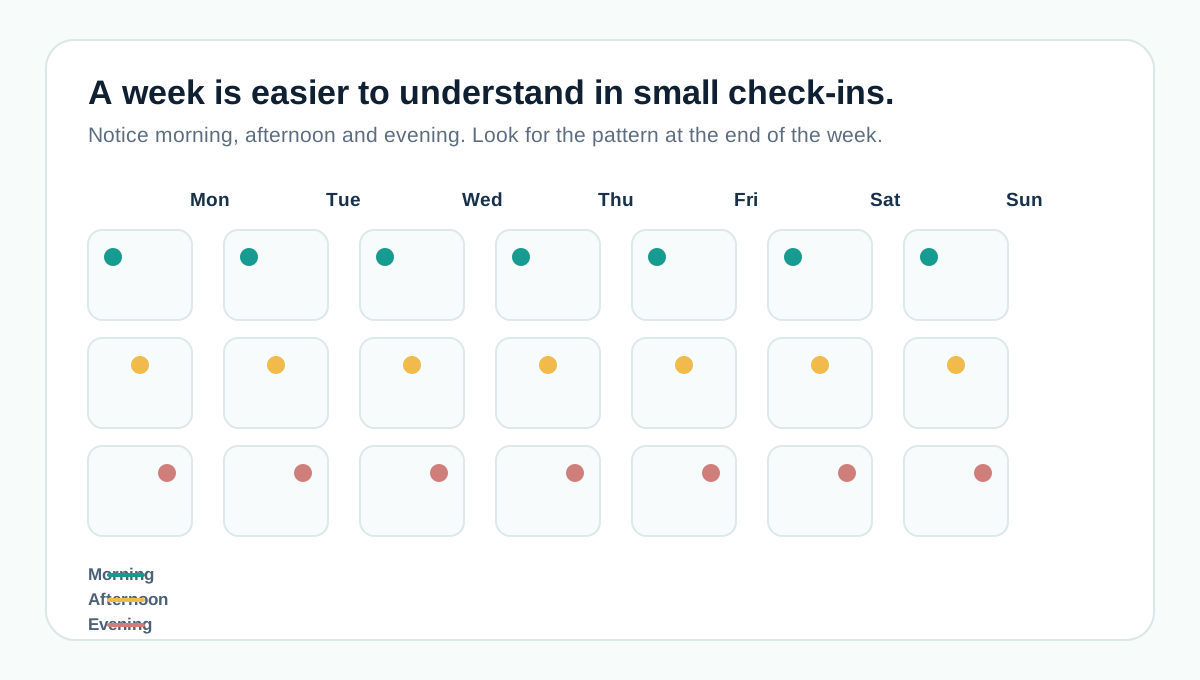
A gentle seven-day method
Choose an ordinary week rather than an ideal one. Do not begin during a holiday, a major crisis or a week you are deliberately trying to improve. For seven days, make three small notes: morning, afternoon and evening. Write only what you would recognise later. “School run and emails”, “train delayed”, “cooked, watched television, called Mum” is enough.
At the end of the week, place the notes into four human categories. You do not need precise timestamps unless they help you.
- Fixed time: work, study, appointments, classes and travel that were difficult to move.
- Care and maintenance: sleep, meals, housework, caring, errands and life admin.
- Restoring time: rest, friends, family, movement, hobbies, reading and unhurried moments.
- Open or drifting time: the gaps that were not planned, including screen time, waiting and time that simply disappeared.
None of these categories is morally better than the others. Sleep belongs in care. A quiet evening may be restoring. A screen can be work, connection or recovery. The labels are only there to help you see the pattern rather than judge it.
A worked example: finding the hidden edge
Imagine a fictional Wednesday: a 45-minute commute, a workday that runs a little late, a grocery stop, dinner, two short household tasks and an hour of personal scrolling before bed. Nothing in that list is unusual. But if the grocery stop, late finish and scrolling pattern happen most weekdays, the visible "free evening" is not really as free as it first appears.
The useful question is not "Where did I fail?"
It is: "Which repeated edge could become easier?" A delivery slot, a shared errand, a prepared dinner, a shorter online task or one calmer phone boundary might be more realistic than attempting a total reset.
This is why an audit is different from a productivity tracker. It helps separate genuinely valuable rest from friction that quietly takes more than it gives. The answer may be a practical change, a clearer request for help or simply an honest decision not to add another commitment next week.
Ask three useful questions
When the week is visible, resist the urge to optimise everything. Instead, ask questions that make room for reality.
- Which part of the week gave me more than it took? This may be a walk, a family meal, a project, a call or simply an earlier night.
- Where did the day become harder than expected? Look for friction: travel, transitions, decision fatigue, duplicate errands or a routine that asks too much at the wrong time.
- What is one small block worth protecting next week? Choose something specific: Wednesday dinner without screens, a Saturday morning walk, 30 minutes before work, or one train journey without inboxes.
This is a much better starting point than “I need more free time”. You may discover that you do not need a completely different life. You may need one clearer boundary around a valuable hour you already have.
Use the calculator after the audit
Once you have observed a real week, use the My Remaining calculator to reflect the parts that are genuinely recurring: sleep, paid work or study, travel and routines, chores, personal screen time and planned leisure. The calculator is deliberately broad. Your audit gives the numbers a reality check.
Change only the assumption that feels furthest from your lived week. If travel is normally 90 minutes rather than an hour, use that. If personal screen time is not the same as work screen time, keep them separate. If a regular class or caring commitment is missing, add it as a custom activity. A useful result is not the most flattering result. It is the one that helps you decide what to protect, reduce or discuss.
Turn one observation into an experiment
A time audit becomes useful when it creates a small, reversible experiment. You might move a grocery shop online for one month, batch an errand with a journey you already make, leave one evening unplanned, walk for 20 minutes after work, or charge your phone outside the bedroom. The aim is to test a change in the rhythm of real life, not to force a permanent identity.
Write down what success would look like before you start. “I want two calmer evenings” is more useful than “I want to be better with time”. Review the experiment after two weeks. Keep what gave you energy or connection. Let go of what only added pressure.
When the week is genuinely too full
Sometimes an audit reveals that there is no hidden spare hour. Work, caring, health, money, travel or family responsibilities can make a routine genuinely crowded. That is not a personal failure. In that situation, the most helpful outcome may be a more honest conversation about support, workload, boundaries or what can wait.
My Remaining cannot solve those pressures. It can help put them into words: this is how much of the week is already spoken for, this is the part I want to protect, and this is the trade-off I am making. That can be a useful starting point with a partner, family member, manager or friend.
Frequently asked questions
Do I need to track every minute?
No. Three short daily notes are enough for most people. Precision is useful only if it helps you notice something you would otherwise miss.
Should I count sleep as unproductive time?
No. Sleep is essential care, not an obstacle to remove. A useful audit makes rest visible alongside obligations.
What if my week is different every time?
Choose a typical week, then note what changes. For shift work, caring or self-employment, patterns may appear across a fortnight or month instead.